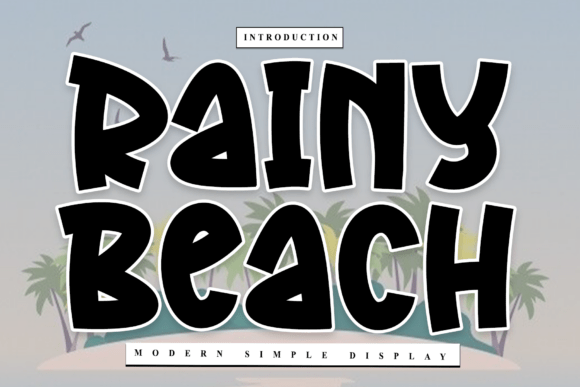
Rainy Beach Font Evaluation
In the landscape of digital and print typography, selecting the right typeface is rarely a purely aesthetic decision; it is a strategic communication tool. Rainy Beach has emerged as a distinct option for designers seeking to convey warmth, craftsmanship, and organic elegance without sacrificing readability. This script font occupies a specific niche between formal calligraphy and casual handwriting, offering a rhythmic quality that can elevate branding and editorial projects.
For professionals evaluating this typeface, understanding its structural nuances and intended applications is crucial. The following analysis explores the characteristics of Rainy Beach, its practical benefits, potential limitations, and scenarios where it serves as an optimal choice compared to other market alternatives.
Defining the Aesthetic: Structure and Style
Rainy Beach is fundamentally a sophisticated script font designed to balance calligraphic style with a warm, organic aesthetic. Unlike rigid serif fonts or geometric sans-serifs, this typeface relies on fluidity and movement. Its most defining characteristic is the use of sweeping, looping ascenders. These tall, upward strokes do not merely extend vertically; they curve and loop in a manner that mimics the motion of a pen gliding across paper.
This design choice creates a sense of customized, artisanal artistry. The loops are not uniform mechanical repetitions but vary slightly in weight and curvature, suggesting a human touch. When paired with its lowercase counterparts, which often feature connected letterforms, the font establishes a continuous rhythm. This rhythm is essential for creating a cohesive visual identity, particularly in contexts where the brand story revolves around tradition, handmade quality, or personal care.
Primary Applications and Use Cases
The versatility of Rainy Beach allows it to function effectively across several high-end industries. However, its strength lies primarily in display settings rather than body text. Designers typically deploy this font in situations where immediate emotional resonance is required.
- Artisanal Food Branding: For businesses selling small-batch jams, craft coffee, or organic skincare, the organic feel of Rainy Beach reinforces the narrative of natural ingredients and manual production processes.
- Boutique Product Packaging: On labels for wine, candles, or luxury soaps, the font adds a layer of exclusivity. The sweeping ascenders draw the eye upward, making the logo memorable and distinct on crowded retail shelves.
- Upscale Lifestyle Marketing: In advertising campaigns for travel, hospitality, or fashion, the font conveys a relaxed yet refined atmosphere. It suggests a lifestyle that is curated and thoughtful.
- Creative Editorial Titles: Magazine headers, book covers, and blog post titles benefit from the font's ability to stand out while maintaining a classic literary feel.
Benefits of Selecting Rainy Beach
When comparing available script options, Rainy Beach offers several distinct advantages. First, it strikes a balance between legibility and flourish. Many decorative scripts sacrifice readability for artistic effect, rendering them difficult to read at smaller sizes. Rainy Beach maintains clear character distinction even within its flowing forms, ensuring that the message remains accessible.
Second, the font provides a unique tonal quality. It avoids the stiffness of formal cursive and the informality of graffiti-style scripts. Instead, it projects an image of "warm sophistication." This makes it particularly effective for brands that want to appear premium without being intimidating or cold. The organic aesthetic also aligns well with current design trends that favor sustainability and authenticity.
Furthermore, the rhythmic nature of the font aids in visual hierarchy. The variation in stroke width and the prominent ascenders create natural focal points. This allows designers to guide the viewer's attention through a layout more intuitively, using the font's inherent movement to dictate the reading flow.
Tradeoffs and Practical Considerations
While Rainy Beach is a powerful tool, it is not universally applicable. There are significant tradeoffs to consider before integrating it into a project. The primary limitation is its suitability for long-form content. Due to its complex letter connections and decorative elements, Rainy Beach is generally unsuitable for body text, especially in small point sizes. Reading extended paragraphs in a script font can cause eye fatigue and reduce comprehension speed.
Another consideration is compatibility with other typefaces. Because Rainy Beach is visually dominant, pairing it requires careful selection. It should ideally be paired with a neutral, clean sans-serif or a simple serif to provide contrast. Using two script fonts together often results in a cluttered and chaotic design. Additionally, the font may require kerning adjustments when used in all-caps or specific ligature combinations, as the sweeping loops can occasionally encroach upon adjacent letters if spacing is not meticulously managed.
Technical implementation is also a factor. While modern web fonts have improved significantly, script fonts can sometimes render inconsistently across different browsers or operating systems, particularly regarding the smoothing of curves. Designers must test the font across various devices to ensure the "artisanal" look translates correctly to digital screens.
Decision Framework: When to Choose Rainy Beach
To determine if Rainy Beach aligns with your specific goals, consider the following decision framework. If your project requires conveying a sense of handcrafted quality, emotional connection, or boutique exclusivity, this font is likely a strong fit. It is particularly effective when the visual identity needs to communicate "human-made" rather than "mass-produced."
Conversely, if your project prioritizes data density, technical precision, or rapid information scanning, alternatives may be worth considering. For example, a financial report or a medical device interface would be better served by a highly legible sans-serif typeface. Similarly, if you need a font that works equally well for headlines and long paragraphs, a variable font with multiple weights and styles might be a more practical investment than a specialized script like Rainy Beach.
Evaluating Alternatives
The market contains numerous script fonts, each with its own strengths. If Rainy Beach feels too ornate for your needs, simpler script fonts that mimic standard handwriting might offer better clarity. On the other hand, if you find Rainy Beach lacks sufficient flair, more elaborate calligraphic fonts with heavier swashes could provide the dramatic impact you seek. The key is to evaluate the specific tone of your brand against the visual weight of the font.
Ultimately, the success of Rainy Beach depends on context. It is a premier choice for specific applications where its unique rhythm and organic aesthetic enhance the brand story. By carefully weighing its benefits against its limitations, designers can make informed decisions that result in cohesive and effective visual communication.
For those seeking to infuse their projects with a sense of warmth and artisanal pride, Rainy Beach stands as a compelling candidate. However, like any typographic tool, its value is realized only when applied with intention and an understanding of its structural capabilities.