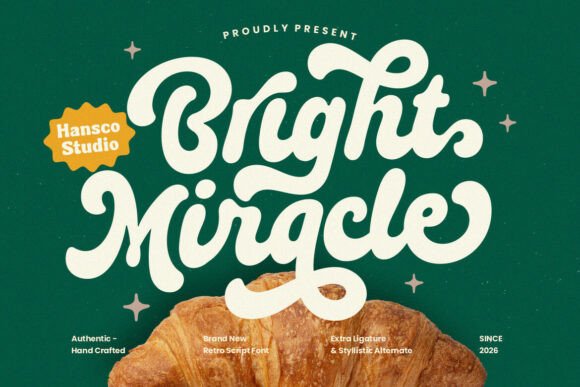
Bright Miracle: A Retro Script for Modern Branding
In the crowded landscape of digital design, finding a typeface that balances whimsy with genuine sophistication is a persistent challenge. Many retro scripts lean too heavily into nostalgia, resulting in designs that feel dated or overly playful rather than elegant. Bright Miracle enters this space as a distinct alternative, offering a font family that successfully merges fluid motion with a sense of "bubbly" refinement. For professionals ranging from bakery owners to lifestyle magazine editors, this typeface represents more than just a stylistic choice; it is a functional tool designed to elevate brand identity through handcrafted aesthetics.
The core appeal of Bright Miracle lies in its unique stroke weight and organic curvature. Unlike many script fonts that mimic the erratic nature of quick handwriting, this typeface maintains a consistent thickness throughout its glyphs. The strokes are described as thick and creamy, providing a visual weight that commands attention without sacrificing readability. This characteristic makes it particularly effective for high-impact applications where legibility is paramount, such as food packaging or large-format social media graphics. The "hand-lettered" illusion is achieved not through chaos, but through carefully engineered curves that suggest human touch while retaining the structural integrity required for professional output.
Design Characteristics and Technical Flexibility
What distinguishes Bright Miracle from standard display fonts is its extensive library of alternate characters. The inclusion of extra ligatures and stylistic alternates allows designers to break away from rigid, repetitive letter combinations. In practice, this means that a word like "Miracle" or "Sweet" can be rendered with varying degrees of connection and flow, mimicking the natural variations found in custom calligraphy. This level of customization is crucial for brands seeking a bespoke look without commissioning expensive custom lettering services.
From a technical standpoint, the implementation of PUA (Private Use Area) encoding ensures broad compatibility across design software. Designers often struggle with font files that require complex OpenType feature toggles or specific software versions. By utilizing PUA encoding, Bright Miracle simplifies the workflow, allowing users to access swashes and special glyphs directly within their preferred tools, whether they are using Adobe InDesign, Illustrator, or Canva. This accessibility reduces the friction between creative vision and final execution, making the font a practical asset for freelancers and small business owners who may not have dedicated technical support.
- Fluid Motion: The curves are designed to guide the eye naturally, creating a sense of movement that feels organic rather than mechanical.
- Consistent Weight: Thick, creamy strokes ensure visibility even at smaller sizes or on textured backgrounds.
- Stylistic Variety: Multiple alternates allow for unique word formations that prevent visual monotony.
Strategic Applications in Branding and Packaging
The versatility of Bright Miracle makes it suitable for a diverse range of industries, though it shines brightest in sectors where warmth and approachability are key selling points. For the culinary industry, specifically bakeries and artisanal food producers, the font's aesthetic aligns perfectly with the desire to convey freshness and homemade quality. When applied to product labels or menu boards, the typeface suggests that the contents are crafted with care, enhancing the perceived value of the product.
Similarly, lifestyle magazines and editorial projects benefit from the font's ability to serve as a hero element. Its polished yet playful nature works well for section headers, pull quotes, or cover lines. However, the effectiveness of the font relies heavily on context. It is not a one-size-fits-all solution for all text. The most successful implementations pair Bright Miracle with a minimalist serif typeface. This pairing creates a necessary visual balance; the serif provides stability and readability for body copy, while the script adds character and emotional resonance to headlines. Without this counterbalance, the design risks becoming visually overwhelming or difficult to scan.
Social media graphics and greeting cards also represent a strong use case. In these environments, content must grab attention quickly. The boldness of Bright Miracle ensures that messages stand out in a feed dominated by clean, sans-serif corporate messaging. Whether announcing a new product launch or sending a seasonal greeting, the font communicates a tone of celebration and intimacy.
Evaluating Usability and Long-Term Value
When considering a typeface investment, professionals must evaluate not only immediate aesthetic appeal but also long-term utility. Bright Miracle offers significant flexibility due to its glyph set. The ability to customize lettering for different contexts means that a single license can support multiple branding needs, from primary logos to secondary marketing materials. This scalability is a critical factor for entrepreneurs and startups operating with limited budgets who need versatile assets.
However, there are limitations to consider. As a display script, Bright Miracle is not intended for extended body text. Attempting to use it for paragraphs will compromise readability and fatigue the reader. Its strength is strictly in short phrases, titles, and accents. Furthermore, while the PUA encoding aids compatibility, users should verify that their specific software version supports these private characters correctly before committing to a large-scale project. Testing is always recommended to ensure that the swashes render as expected across different devices and export formats.
The "cozy, stylish world" that the font invites is a powerful psychological cue. In an era of digital minimalism, consumers often respond positively to designs that feel tactile and human. Bright Miracle taps into this sentiment effectively. It bridges the gap between the cold efficiency of modern web design and the warmth of traditional craftsmanship. For educators or creators looking to produce materials that feel personal and engaging, this font provides a reliable mechanism to achieve that tone.
Who Should Consider Bright Miracle?
This typeface is best suited for individuals and businesses that prioritize personality in their visual communication. Freelance graphic designers working on branding packages for boutique clients will find the stylistic alternates invaluable for creating custom looks. Small business owners in the retail or service sector can leverage the font to differentiate themselves from competitors using generic templates. Bloggers and publishers focusing on lifestyle, food, or culture topics will appreciate the font's ability to add a layer of editorial flair to their digital content.
Conversely, projects requiring strict neutrality, high data density, or a futuristic aesthetic may find Bright Miracle unsuitable. It carries a specific mood—one of nostalgia, comfort, and elegance—that does not translate well to every context. Understanding this distinction is essential for maintaining brand consistency. When used appropriately, however, Bright Miracle serves as a robust tool for elevating a brand's narrative. It transforms simple text into a visual experience that resonates with audiences on an emotional level.
Ultimately, the value of Bright Miracle lies in its ability to deliver a high-end, handcrafted appearance with the reliability of a digital font. It removes the guesswork from achieving a sophisticated script look, offering a structured yet flexible foundation for creative work. For those willing to pair it thoughtfully with complementary typefaces and apply it within its intended scope, it stands as a compelling option in the modern designer's toolkit.