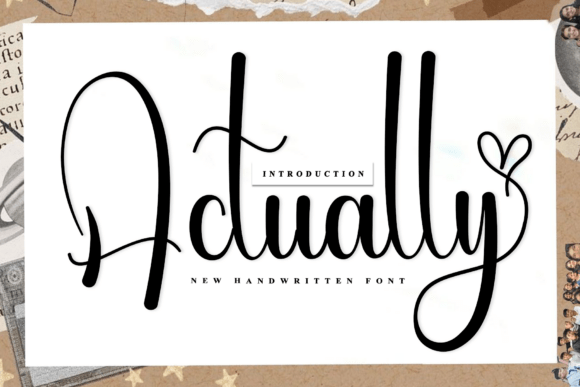
Actually: The Rhythmic Script Font Redefining Artisanal Branding
In the crowded marketplace of modern design, where digital noise often drowns out the subtle nuances of human connection, typography serves as a critical bridge between a brand and its audience. Among the vast array of typefaces available to designers, Actually has emerged as a distinctive voice that speaks directly to the heart of artisanal quality. It is not merely a font; it is a sophisticated and rhythmic script that balances a traditional calligraphic style with a warm, organic aesthetic.
For general readers looking to understand the impact of visual identity, or for business owners seeking to elevate their packaging, understanding the unique characteristics of Actually provides valuable insight into how design choices influence consumer perception. This article explores the anatomy of this font, its practical applications in today's economy, and why it has become a premier choice for upscale lifestyle marketing and creative editorial titles.
Understanding the Anatomy of Actually
To appreciate Actually, one must first look beyond the letters themselves and examine the movement within them. Unlike rigid sans-serif fonts designed for maximum legibility on small screens, or blocky serifs meant to convey stability and tradition, Actually is defined by its fluidity. Its defining characteristic is the use of sweeping, looping ascenders that create a sense of customized, artisanal artistry.
When you view a word set in Actually, your eye does not travel in a straight line. Instead, it follows a rhythm, guided by the graceful curves and dynamic flourishes that mimic the motion of a hand holding a brush or a high-quality fountain pen. This "rhythmic" quality is what sets it apart from standard cursive fonts, which can sometimes appear stiff or overly uniform. The loops are not decorative afterthoughts; they are integral to the structure of the letterforms, providing a sense of flow and continuity.
- Sweeping Ascenders: These tall strokes that extend above the x-height create vertical drama, drawing the eye upward and adding a sense of elegance.
- Organic Aesthetic: The stroke widths vary naturally, simulating the pressure changes of handwriting, which adds warmth and humanity to the text.
- Calligraphic Balance: While inspired by traditional calligraphy, the font is engineered for readability, ensuring that the beauty does not come at the cost of clarity.
This balance is crucial. Many decorative scripts fail because they are difficult to read when used in paragraphs. Actually strikes a perfect chord, offering enough character to be memorable while maintaining the structural integrity required for effective communication.
The Psychology of Warmth and Craftsmanship
Why does a specific font matter so much? In the realm of psychology and branding, typeface acts as a non-verbal cue. When a consumer sees a logo or a package label, their brain instantly categorizes the product based on these visual signals. Actually triggers a specific response: trust in craftsmanship and an appreciation for the handmade.
In an era dominated by mass production and algorithmic precision, there is a growing cultural desire for things that feel "real." Consumers are increasingly drawn to brands that emphasize sustainability, local sourcing, and manual labor. The warm, organic aesthetic of Actually aligns perfectly with these values. It suggests that a person touched the product, poured care into its creation, and values the imperfections that make it unique.
This is particularly relevant for businesses in the artisanal food sector. Imagine a jar of small-batch honey or a box of handcrafted chocolates. If the packaging features a sterile, geometric font, it feels industrial. However, if the label uses the sweeping loops of Actually, it immediately communicates that the contents inside are likely just as carefully curated. The font becomes a promise of quality before the customer even opens the package.
Practical Applications in Modern Business
The versatility of Actually makes it a powerful tool across various industries. Its ability to convey sophistication without being pretentious allows it to fit seamlessly into diverse contexts.
Artisanal Food Branding
As mentioned, the food industry is perhaps the most natural home for this typeface. From craft breweries to boutique bakeries, Actually helps tell the story of heritage and recipe. It works exceptionally well for:
- Menu Titles: Creating a hierarchy that guides the diner's eye through complex offerings.
- Ingredient Lists: Adding a touch of class to simple descriptions of fresh produce.
- Logo Design: Serving as the centerpiece of a brand identity that needs to stand out on a shelf.
Boutique Product Packaging
For companies selling luxury goods, cosmetics, or fashion accessories, the tactile feel of the product is paramount. Actually translates well to embossing, foil stamping, and letterpress printing. The deep grooves created by the sweeping ascenders catch light beautifully, enhancing the perceived value of the item. It transforms a simple box into a piece of art, encouraging customers to keep the packaging rather than discard it.
Upscale Lifestyle Marketing
In advertising campaigns for travel, real estate, or high-end services, the goal is often to evoke a feeling of exclusivity and refined taste. Actually provides the necessary gravitas. It avoids the casualness of handwriting but retains the approachability of a personal note. This makes it ideal for editorial headlines in lifestyle magazines, where the text needs to grab attention while maintaining an air of sophistication.
Creative Editorial Titles
Writers and editors know that the right font can change the tone of an entire article. When introducing a feature story about a master carpenter or a vintage wine cellar, a standard serif might feel too academic. Actually brings a narrative flair, suggesting that the story within is rich, detailed, and deeply human.
Clarifying Misunderstandings About Script Fonts
Despite its popularity, there are common misconceptions about using script fonts like Actually in professional settings. One frequent error is assuming that script implies informality. While some scripts are playful and cartoonish, Actually belongs to a more formal, elegant category. It should not be confused with "party invitation" fonts; it carries weight and authority.
Another misunderstanding involves legibility. Some designers believe that any script is inherently hard to read. While it is true that Actually is best used for short phrases, headlines, and logos, it requires careful kerning (spacing) to ensure the loops do not collide. However, when used correctly, it offers excellent readability for display purposes. It is not intended for long blocks of body text, but rather for the moments where you want the reader to pause and appreciate the message.
Furthermore, there is a myth that custom fonts are only for large corporations with massive budgets. With the rise of digital licensing and online marketplaces, accessing premium typefaces like Actually is more accessible than ever. Small businesses and independent creators can now leverage the same visual tools as global giants, leveling the playing field in terms of aesthetic quality.
Fitting Into the Digital Landscape
One might wonder how a font rooted in analog traditions fits into our digital-first world. Does Actually lose its charm on a smartphone screen? Surprisingly, no. Because of its clean lines and distinct character shapes, it renders beautifully on high-resolution displays. In fact, the contrast between the thin hairlines and thick downstrokes creates a striking visual effect on mobile devices, making it an excellent choice for social media graphics and website headers.
In the context of user experience (UX), Actually serves as a focal point. It breaks up the monotony of standard web typography, guiding users toward key calls to action or important announcements. When used sparingly, it enhances the overall aesthetic without overwhelming the content. This strategic placement is key to modern web design, where balance and restraint are valued over excess.
Conclusion: The Enduring Power of Handcrafted Style
Ultimately, Actually represents more than just a collection of characters; it embodies a philosophy of design that values human touch, rhythm, and organic beauty. Whether you are a graphic designer looking to add depth to a project, a business owner aiming to differentiate your brand, or simply someone who appreciates the art of typography, understanding Actually opens up new possibilities for creative expression.
In a world that often feels automated and impersonal, the sweeping, looping ascenders of Actually remind us of the value of craftsmanship. They invite us to slow down, to look closer, and to appreciate the details that make life—and design—richer. As we move forward into a future filled with artificial intelligence and automation, the demand for authentic, human-centric design will only grow. Actually stands ready to meet that demand, offering a timeless solution for those who wish to communicate with warmth, elegance, and artistic flair.
By integrating such a sophisticated tool into your projects, you are not just choosing a font; you are choosing a narrative. You are telling your audience that you care about the details, that you value quality, and that your brand is built on a foundation of genuine artistry. That is the true power of Actually.